Posted by Many Mini Trucks of Franklin, NC
So you’ve spotted one of those little Japanese mini trucks buzzing around a farm or job site and thought — what IS that thing, and where do I get one? You’re not alone. Kei trucks have been quietly winning over farmers, contractors, and outdoor enthusiasts all across western North Carolina, and for good reason.
If you’re thinking about buying one, here’s everything you need to know before you do.
First Things First — What’s a Kei Truck?
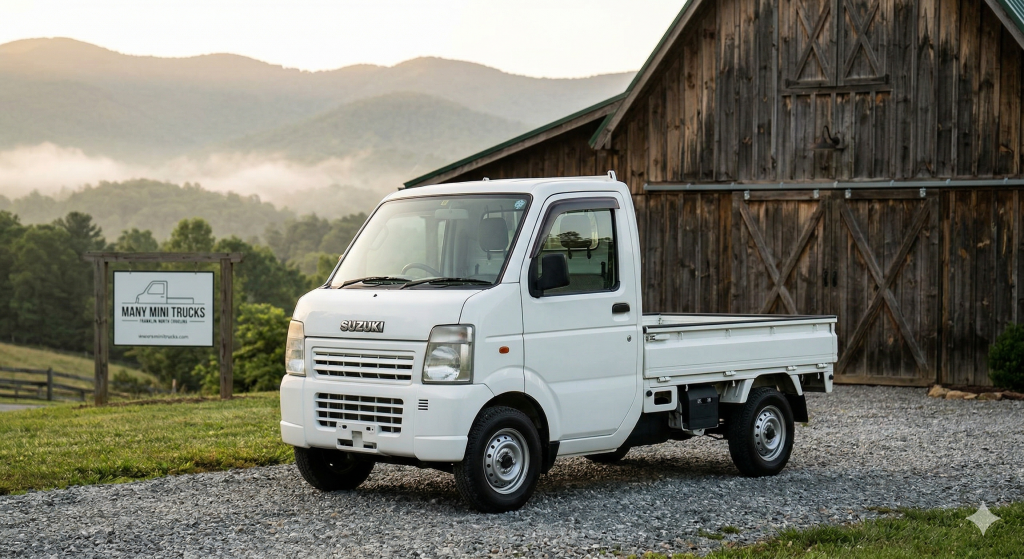
Kei trucks (sometimes called Japanese mini trucks or just “mini trucks”) are compact utility vehicles built in Japan. They’re small — think the footprint of a golf cart, but with a real cab, real 4WD, and a real pickup bed. Most run a 660cc 3-cylinder engine, get great fuel economy, and are surprisingly capable in rough terrain.
Common makes include Suzuki Carry, Daihatsu Hijet, Honda Acty, Mitsubishi Minicab, and Subaru Sambar. Each has its fans, and honestly, they’re all solid workhorses.
The appeal? You get most of what a full-size truck does for farm and property work — at a fraction of the cost, in half the footprint.
Are Kei Trucks Street Legal in North Carolina?
Good news — yes, North Carolina is kei-truck friendly. You can register and drive one on most public roads in the state. Here’s what you need to know:
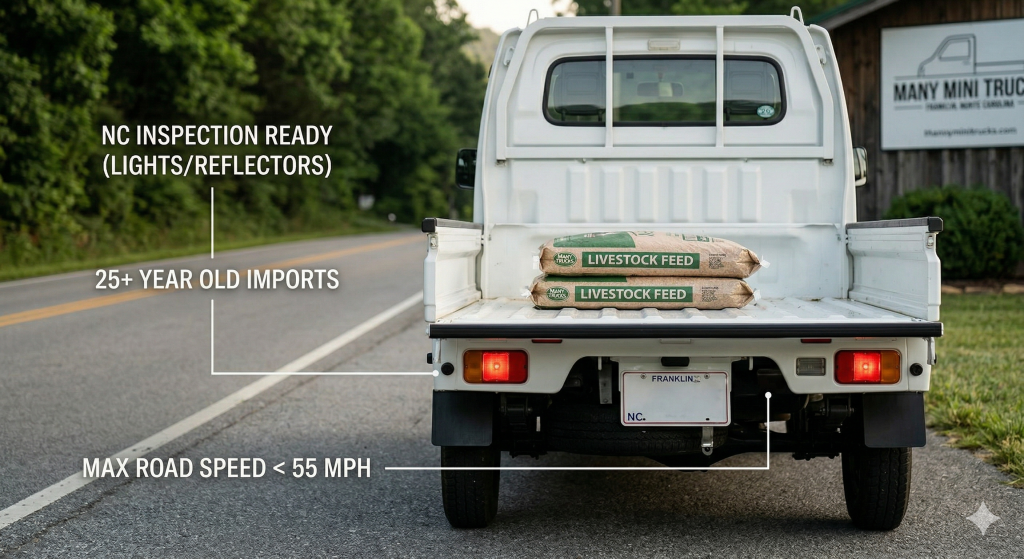
- Speed limits: Kei trucks are allowed on roads up to 55 mph. No interstates, but most county roads and state highways are fair game.
- Required equipment: NC law requires your truck to have headlamps, brake lights, turn signals, tail lights, reflectors, parking brakes, rearview mirrors, windshield and wipers, a speedometer, seat belts, and a VIN. Most kei trucks come with all of this already.
- Registration: You’ll need to register with the NC DMV and have the vehicle inspected, just like any other vehicle.
Local rules can vary by county, so it’s always worth a quick call to your local DMV office to confirm. And since regulations can evolve, we recommend checking with the NC Division of Motor Vehicles for the latest.
The 25-Year Rule — Why Are These Trucks from the ’90s?
If you’ve shopped around a bit, you’ve probably noticed that almost every kei truck for sale in the US is from the mid-to-late 1990s. That’s not a coincidence.
Federal law requires imported vehicles to be at least 25 years old before they can be brought in for road use. So the trucks hitting the market now were built in Japan around 1998–2000 — which actually works out great for buyers. These are vehicles with a long track record, plenty of parts availability, and they’ve already proven they can go the distance.
Who’s Buying Kei Trucks in NC — and Why?
We sell to all kinds of folks, but a few groups really love these trucks:
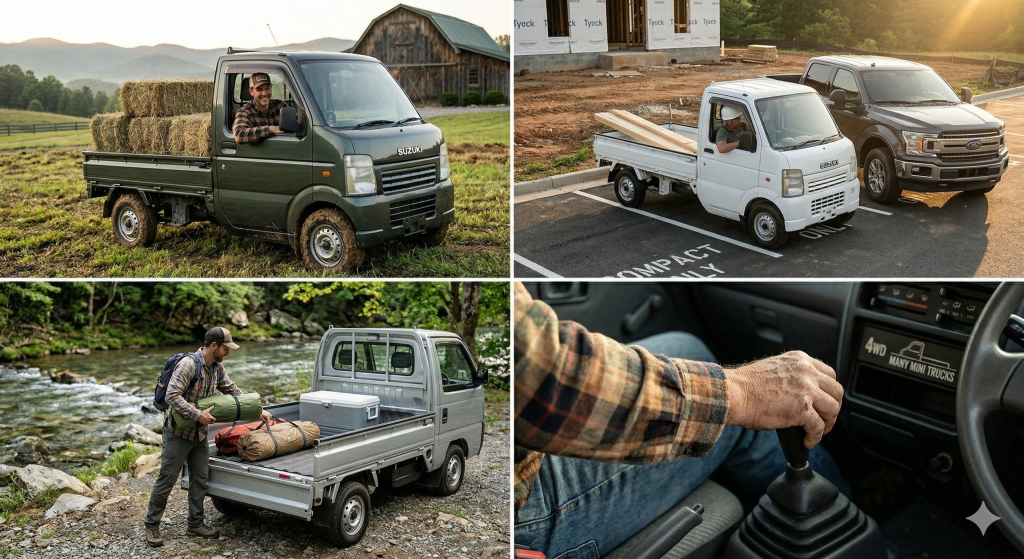
🌾 Farmers and homesteaders use them to haul feed, move equipment, check fence lines, and get into tight spots a full-size truck just won’t go. The low-speed 4WD is a game changer on wet or hilly ground.
🏕️ Outdoor enthusiasts love them for hunting access roads, campground maintenance, trail work, and property exploration. They’re tough, they’re fun, and they don’t break the bank.
🔨 Contractors and tradespeople appreciate the maneuverability on tight job sites — parking next to a building or navigating a narrow lot is no problem — plus the payload capacity gets the job done.
If any of those sound like you, chances are a kei truck will earn its keep quickly.
What to Look for When You’re Shopping
Most kei trucks you’ll find in the US are 25+ years old, so condition is everything. Here’s what to check:
- Rust — especially the frame and bed floor. These trucks were built for dry Japanese conditions, so rust can be an issue on ones that weren’t well cared for after import.
- 4WD engagement — get in and test it. Make sure it shifts smoothly into 4WD and back.
- Fluid leaks — a quick look underneath tells you a lot about how the truck’s been maintained.
- Odometer — Japanese odometers read in kilometers. Divide by 1.6 to get miles. A truck showing 45,000 km has roughly 28,000 miles on it.
- Title and import docs — make sure there’s a clean title and proper paperwork. This matters a lot for NC registration.
When you buy from a dealer, you get someone who’s already done this homework — and who you can call if questions come up after the sale.
A Word on Insurance
Insuring a kei truck is usually straightforward, but not every insurer is familiar with them. Call your agent before you buy and let them know what you’re looking at. Most standard auto policies will cover them once they’re registered, but it’s worth confirming first.
Come See What We Have
We’re Many Mini Trucks, right here in Franklin, NC — and we keep a rotating inventory of inspected kei trucks ready to go. Whether you’re after a Suzuki Carry for the farm, a Daihatsu Hijet for the job site, or something to get you back on the trail, we’d love to help you find the right fit.
👉 Browse our current inventory and see what’s available.
📞 Or give us a call — (828)-634-1085 we’re happy to talk through what you need and point you in the right direction, even if you’re still just kicking the tires.
We’re local, we know these trucks inside and out, and we’re not going to pressure you into something that’s not the right fit. Come say hi.
Have a question we didn’t cover? Drop it in the comments below or send us a message — we love talking mini trucks.
Great content! Keep up the good work!